|
 |
受信日時:2008 / 04 / 01 11:52:32 グレード :

|
 |
名前 |
Marcel Morin |
日本のココが好き |
Onsens |
国籍 |
Canadian |
日本のココがちょっと |
Summer |
|
教師哲学 |
Just do it!!! |
好きな言葉 |
Life,Love,and the Universe |
|
 |
| 01. |
Hello Eigobin01, |
| 02. |
|
| 03. |
How are you doing?
|
|
04. |
Last time you sent me an e-mail, you mentioned
that unexpected affair
things
make
your life more interesting sometimes
, right? . |
| 05. |
.I can't agree with you more.
I want to share my experience with you.
|
| 06. |
That was It reminded me
of my first trip to Paris. When I and my friend were
walking down
the a lovely street,
someone called my name from the
other side of the road. |
| 07. |
We didn't
know anybody in Paris. The person
who knew my name came up to us. |
| 08. |
Few seconds later, we recognized her.
Yes, that It was
my a friend whom
I met in Canada.
|
| 09. |
She told us that she was just visiting
Paris with her parents , too
.
|
| 10. |
|
| 11. |
|
| 12. |
.I thought
what it's really a
small world
to run into my
Canadian friend in Paris after not seeing them
for such a long time!
|
| 13. |
|
| 14. |
Eigobin02 |
| 15. |
|
| 16. |
|
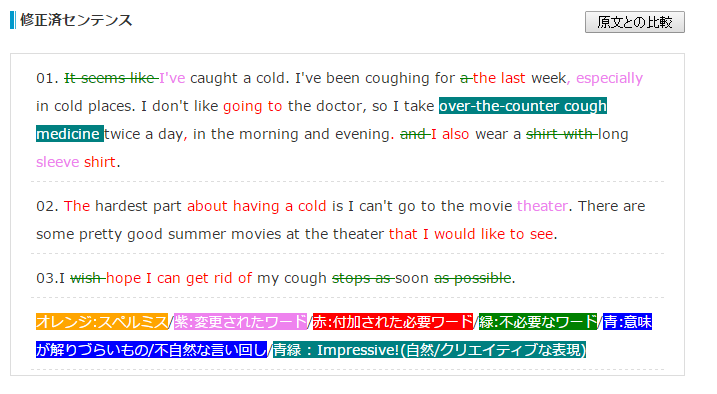
紫:変更されたワード/赤:付加された必要ワード/緑:不必要なワード/青:意味が解りづらいもの
/ 青緑
: Impressive!(自然/クリエイティブな表現)
|
 |
|
 |
| 01. |
|
| 02. |
|
| 03. |
|
| 04. |
'Things' is more natural here. You don't
need 'your' if you are making a general statement.
We usually use the plural form to make a general statement.
|
| 05. |
You don't need to 'introduce' what you
are going to right about. You can just go straight into
it.
|
| 06. |
We use 'a' to refer to one of many.
Use 'the' when you are referring to specific things. |
| 07. |
You need past tense because you are writing
about that time.
|
| 08. |
You are not answering a question so it's
a little strange to start with 'yes'.
'Whom' is overly formal. You don't need it here. |
| 09. |
Only use 'too' if you are visiting with
your parents as well. |
| 10. |
|
| 11. |
|
| 12. |
Use 'it's' to be more direct.
Good understanding of the challenge phrase.
You should always capitalize nationalities.
You need to mention who you saw (them).
The common expression is 'for a long time'.
|
|
13. |
|
| 14. |
Don't forget to put your name at the end. |
| 15. |
|
| 16. |
|
 |
|
|
 |
 |
受信日時:2008 / 04 / 03 11:52:32 グレード :

|
 |
名前 |
Marcel Morin |
日本のココが好き |
Onsens |
国籍 |
Canadian |
日本のココがちょっと |
Summer |
教師哲学 |
Just do it!!! |
好きな言葉 |
Life,Love,and the Universe |
|
カテゴリ:その他一般 添削の厳しさ:辛口 講師に伝えたいこと |
 |
| 01. |
Finding " Spring"
|
| 02. |
|
| 03. |
A few days ago,
my 4 year old son
had come came home
from
the kindergarten
and said to me , " Mama, let's walk
to
the kindergarten
tomorrow morning. " |
| 04. |
While I was nodding to him I was wondering
why he requested that
to me
out of the blue .
|
| 05. |
.He loves the bike his
ride,
especially on the way to go to
the kindergarten
every morning. |
| 06. |
|
| 07. |
Then I found out from his teacher that
they went for walk to "find the Spring " on that day. |
| 08. |
The teacher
reported told us
; mothers that
under in the beautiful
weather the kids used their
whole bodies and felt the
spring ( Warm sun, gentle breeze,
tiny flowers , and bugs
) . The teacher also
pointed out that children's eye-level is much closer to
the ground than adults'. |
| 09. |
Their view
( = or
' world '
) is completely different from what we see.
|
| 10. |
|
| 11. |
After I heard this, I tried to imagine
my son
's " finding the spring "
experience . |
| 12. |
What a wonderful concept it is! Once you
grown up, you are so busy and tend to
choose more convenient and efficient
life style. However;
you may miss a lot
s of the beautiful
elements of life at the same time.
|
| 13. |
You should sometimes
"stop and smell the roses " .
that's what it is .
|
紫:変更されたワード/赤:付加された必要ワード/緑:不必要なワード/青:意味が解りづらいもの/青緑
: Impressive!(自然/クリエイティブな表現)
|
 |
|
 |
| 01. |
|
| 02. |
|
| 03. |
The common expression is 'a few days...'.
You don't need past perfect (had come) when past events
are in a logical order.
All you need is a comma before a direct statement.
You don't need 'the' because you are not referring
to a specific place. |
| 04. |
'To me' is understood from context so
you don't need it.
Great expression to use.
|
| 05. |
Use 'his' to make it more personal. |
| 06. |
|
| 07. |
|
| 08. |
'Reported' is a little too formal here.
We usually do things 'in' certain weather.
We often put extra information in parenthesis.
You can use 'or' to give an alternative. |
| 09. |
|
| 10. |
|
| 11. |
You don't need the possessive form because
'experience' is understood from the context.
|
| 12. |
Using 'life style' this way is kind of
Japanese English. I would use '...focus on convenience
and efficiency'.
You can use 'a lot' or 'lots'.
It seems like you want to give advice so you should
use 'should'.
Wonderful expression to finish with.
|
| 13. |
|
 |
|
通常の(ベーシック)添削では、200文字単位に1枚の添削チケットをご利用いただきます。
その他、200文字単位で添削チケットを2枚ご利用いただく”プライム”添削があります。
(添削提出時にお選びいただけます)
プライム添削の特長
@ 好きな講師を指名できます
A 添削結果にライティングのワンポイントアドバイスがつきます
B 担当講師へメールで1回疑問点を質問できます。
ワンポイントアドバイス例 (最も注意すべき点、または次回への課題などを講師が指摘します)
| |
(サンプル1)
This email has a lot of good advice, but
it's a little stiff. Using
'first, second, third' is rather business-like. You can make
things
more personal by writing more directly to the person or making
suggestions (e.g. line #9 - You should fix your shelves so they
don't
fall down, line #11 - It's also a good idea to have...) .
|
|
| |
(サンプル2)
This essay is clearly laid out and easy
to follow. It would be even
stronger if you add more detail to each of your arguments (e.g.
line
#03 - This certification insures a certain standard of knowledge
for
all teachers, line #05 - It happens over a long period of time).
With
'a', whenever you need a noun, ask yourself "is this one
of many?" If
the answer is "yes", you need 'a'.
|
|
| |
|
|
※ 特定の講師と続けてやりとりすることで、講師もよりメンバーを理解し、一緒の学習目標に向かってよりよいアドバイスを提供することが可能となります。
|